Beacons of the Past: The Keepers, Towers, and Tides That Defined Ogunquit's Maritime Soul
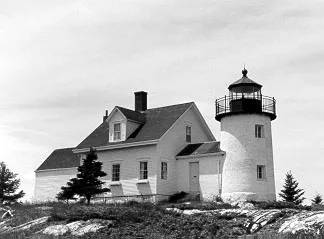
Photo: US Coast Guard, Public domain, via Wikimedia Commons
For generations of sailors navigating the cold, unforgiving waters off the southern Maine coast, a lighthouse was more than a structure — it was a promise. It meant that somewhere on shore, a dedicated keeper had trimmed the wick, polished the lens, and climbed the tower stairs to ensure that the light would burn through the night. Along the stretch of coastline that today draws visitors to Ogunquit for its beauty and tranquility, those promises were made and kept for well over a century. Yet the towers themselves, and the men and women who tended them, have largely faded from public memory.
The Ogunquit Heritage Museum has spent years working to recover these stories, drawing on archival photographs, keeper logbooks, and the expertise of local maritime historians. What has emerged is a portrait of a community whose identity was inseparable from the sea — and from the lights that made safe passage possible.
A Coast Built on Commerce and Peril
Ogunquit's relationship with the Atlantic was never merely scenic. Throughout the 18th and 19th centuries, the coastline served as a vital corridor for commercial shipping, fishing fleets, and the transport of timber, granite, and other goods essential to the growing American economy. The waters between Cape Neddick to the south and the Kennebunk River to the north were notoriously difficult to navigate, particularly in fog, winter storms, or the unpredictable conditions of the spring thaw.
Local historian and museum contributor Margaret Alcott has described the stretch of coast near Perkins Cove as "a mariner's puzzle" — a network of submerged ledges, shifting sandbars, and tidal currents that claimed numerous vessels over the centuries. Wrecks were not uncommon, and the losses they represented were felt not only in property and cargo, but in human lives drawn from the very fishing families who made their homes in the village.
It was this combination of commercial necessity and human cost that drove early efforts to establish navigational aids along the Maine coast. The federal government, recognizing the economic importance of reliable maritime passage, began funding lighthouse construction throughout New England in the early 19th century, and the Ogunquit region eventually received its share of that investment.
The Architecture of Safety
The lighthouses that once marked this coastline were not uniform in design. Early structures tended toward simplicity — rubblestone towers attached to modest keeper's dwellings, built for function rather than aesthetics. As lighthouse engineering evolved through the mid-19th century, however, the structures became more refined. Cast-iron components, improved Fresnel lenses, and more sophisticated ventilation systems allowed for brighter, more reliable lights that could be seen at greater distances.
Architectural records held by the museum document at least two principal lighthouse installations in the broader Ogunquit area during the peak years of coastal commerce. These towers, while modest by the standards of larger harbor lights such as Portland Head Light, were nonetheless significant engineering achievements for their time and place. Their siting was carefully calculated to maximize visibility from the most dangerous approach angles, and their construction required substantial labor from local craftsmen.
Photographs from the museum's collection, some dating to the 1870s and 1880s, show these structures in their operational prime — whitewashed towers rising against gray skies, keeper's gardens tucked behind low stone walls, and the ever-present Atlantic stretching to the horizon beyond. There is a quiet dignity to these images that speaks to the serious purpose these buildings served.
The Keepers Who Kept the Flame
Perhaps no aspect of lighthouse history is more compelling than the human dimension — the individuals and families who accepted the demanding, often isolated work of maintaining these vital aids to navigation. Lighthouse keeping was a federal appointment, and the records of the United States Lighthouse Board provide a partial roster of those who served along this stretch of the Maine coast.
Among the most thoroughly documented is Elias Perkins, who served as keeper at one of the Ogunquit-area lights from approximately 1854 to 1871. His logbooks, preserved in the museum's archive, offer a remarkable window into the daily rhythms of lighthouse life. Perkins recorded weather conditions with meticulous consistency, noted the passage of vessels he recognized, and documented the periodic inspections conducted by district superintendents. He also wrote, in careful and sometimes eloquent prose, about the storms that tested both the structure and his own resolve.
"The gale came upon us with very little warning," he wrote in an entry from January 1863. "By midnight the sea was breaking over the lower rocks and the wind had shifted to the northeast. I kept the light burning through the whole of it, though the lantern room was shaking in a manner that gave me considerable unease."
The families of keepers shared in both the hardships and the peculiar rewards of coastal life. Children grew up within earshot of the surf, educated at home or in the village schoolhouse, and developed a familiarity with maritime conditions that served many of them well in later life. Several descendants of Ogunquit-area keepers remain in the region today, and the museum has benefited greatly from their willingness to share family letters, photographs, and oral histories.
Decline, Abandonment, and the Question of Memory
The story of Ogunquit's lighthouses is ultimately one of loss. As the 20th century advanced, technological changes — automated buoys, improved charts, and eventually electronic navigation systems — rendered many smaller lighthouse installations obsolete. Federal decommissioning programs in the mid-20th century saw numerous structures along the Maine coast either demolished or transferred to private ownership, often without adequate provision for their preservation.
The lighthouses that once marked the Ogunquit coastline did not survive intact. Some were dismantled; others succumbed to the combined forces of weather, neglect, and the relentless encroachment of development. What remains today are fragments — a section of stone foundation visible at low tide, a keeper's dwelling repurposed as a private residence, and the archival materials that organizations like the Ogunquit Heritage Museum have worked to collect and conserve.
This loss carries real cultural weight. As local historian Thomas Gilman has observed, lighthouses were not merely functional objects; they were landmarks in the deepest sense, structures around which communities organized their sense of place and identity. Their disappearance has left gaps in the landscape that are not always visible but are nonetheless felt.
Preservation Through Story
The mission of the Ogunquit Heritage Museum has never been limited to the preservation of physical objects, important as that work is. Equally vital is the preservation of narrative — the stories that give those objects meaning and connect the present community to its past. In the case of the region's lighthouses, that narrative work has taken on particular urgency, precisely because so little of the physical record survives.
The museum's ongoing lighthouse documentation project has assembled one of the most comprehensive collections of related materials in southern Maine, including keeper logbooks, architectural drawings, correspondence with the Lighthouse Board, and a growing archive of oral history recordings. These materials are available to researchers and are periodically featured in the museum's exhibitions and public programming.
For visitors to Ogunquit who stand at the edge of Perkins Cove and look out toward the open Atlantic, it is worth pausing to consider what this coastline once meant to those who worked upon it — and what it cost to keep those waters safe. The lights may be gone, but the stories they illuminate endure.