Seaside Diversions and Saturday Nights: A Century of Leisure in Ogunquit, Maine
There is a particular quality to leisure time in a coastal New England town — unhurried yet purposeful, communal yet deeply personal. In Ogunquit, where the rhythms of fishing tides and summer tourism have long governed daily life, the ways in which residents and visitors chose to spend their free hours offer a remarkably candid portrait of American social history. From the gaslit parlors of the Victorian era to the glowing screens of the twenty-first century, the evolution of entertainment in this small Maine community mirrors transformations that unfolded across the entire nation, filtered always through the particular character of a place defined by salt air, rocky shoreline, and an enduring sense of neighborly obligation.
The Victorian Parlor and the Art of Domestic Amusement
In the latter decades of the nineteenth century, leisure in Ogunquit was largely a private affair, conducted within the home and governed by strict social conventions. Families gathered in parlors furnished with horsehair sofas and kerosene lamps to engage in activities that were at once entertaining and morally instructive. Card games such as whist enjoyed enormous popularity, as did parlor charades, recitation evenings, and the reading aloud of serialized fiction from popular periodicals. Music occupied a place of particular prominence: households fortunate enough to possess an upright piano became informal gathering points for neighbors, and evenings of communal singing reinforced bonds of friendship and faith alike.
For Ogunquit's fishing families, leisure was inseparable from the seasonal calendar. The brief reprieve of winter, when boats were hauled and nets mended, offered time for storytelling and craftwork that served both practical and social ends. Scrimshaw, model boat carving, and the braiding of rugs were not merely hobbies but expressions of a community's relationship with its material world. These quiet domestic arts preserved knowledge, passed skills between generations, and gave shape to evenings that might otherwise have stretched empty and cold.
The Arrival of Summer Visitors and the Transformation of Public Entertainment
The late nineteenth and early twentieth centuries brought a new force to Ogunquit's recreational landscape: the summer tourist. As railroads extended their reach into coastal Maine, visitors from Boston, Portland, and beyond arrived seeking rest, sea bathing, and the particular pleasures of resort life. Their presence catalyzed a transformation in the town's public entertainments that would prove lasting.
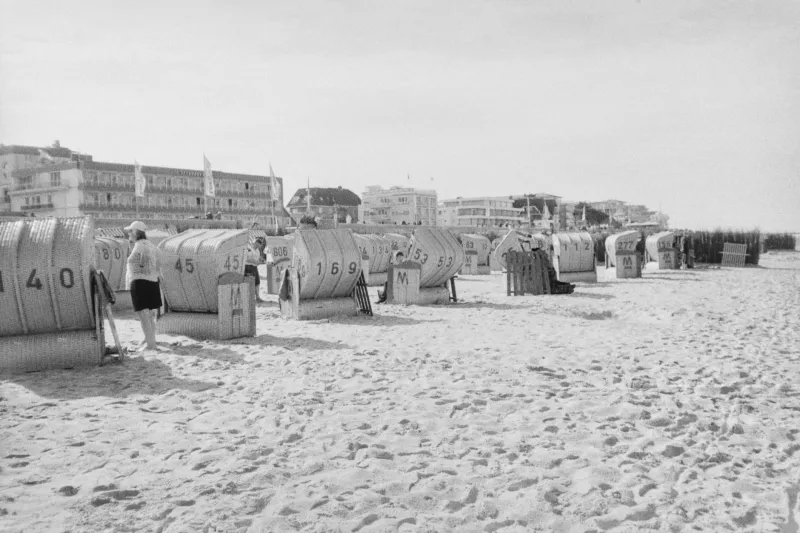
Ogunquit Beach became the center of a modest but vibrant amusement culture. Bathhouses offered changing facilities and rental equipment, while small concession stands dispensed saltwater taffy, lemonade, and ice cream to strolling visitors. Bowling alleys, billiard rooms, and shooting galleries appeared along the commercial strip, catering to a clientele that expected diversion as a natural accompaniment to seaside relaxation. Band concerts performed on open-air platforms drew mixed crowds of residents and tourists, creating rare moments of shared public leisure that temporarily dissolved the social distinctions between the town's working families and its wealthier summer guests.
The establishment of the Ogunquit Playhouse in 1933 marked perhaps the most significant single development in the town's entertainment history. Founded during the depths of the Great Depression, the theater demonstrated a remarkable confidence in the enduring human appetite for live performance. It attracted accomplished actors and directors, many of whom found in Ogunquit's summer season both professional opportunity and personal respite. For local residents, the Playhouse represented something more than culture — it was evidence that their community occupied a place of genuine significance in the broader American artistic landscape.
Mid-Century Modernity and the Democracy of Fun
The postwar decades reshaped leisure in Ogunquit as thoroughly as they reshaped American life everywhere. The automobile democratized access to the town's pleasures, bringing middle-class families from across New England who might previously have found the journey impractical. Motor courts and roadside diners proliferated along Route 1, and the tourist economy expanded to accommodate a broader and more diverse clientele than the grand hotels of the Gilded Age had ever served.
Drive-in movie theaters, miniature golf courses, and arcades appeared in the surrounding region, reflecting national trends toward mass commercial entertainment that required little prior knowledge or social preparation. Television sets, installed in living rooms and eventually in motel lobbies, began to exert their powerful gravitational pull on evening hours. Yet Ogunquit retained a countervailing impulse toward the traditional and the communal. Summer stock theater continued to flourish, art galleries multiplied in response to the colony's growing reputation, and the beach itself remained the town's most democratic entertainment venue — a place where fisherman and vacationer, child and elder, met on genuinely equal terms.
Local organizations sustained a rich calendar of community events throughout the year. Grange suppers, church fairs, and holiday parades provided structure to the social calendar and ensured that leisure remained, in part, a collective rather than merely individual experience. These gatherings carried particular weight during the quieter winter months, when the departure of summer visitors left the town to its year-round residents and the particular intimacy that attends a small community in the off-season.
The Digital Age and the Persistence of Place
The arrival of the internet age posed questions for Ogunquit — as it did for every American community — about the relationship between physical place and virtual experience. Could a town whose identity had always been grounded in the sensory particularity of its coastline, its galleries, and its theaters retain its character as entertainment migrated increasingly to screens and platforms that recognized no geography?
The evidence, to date, suggests a qualified optimism. Digital tools have in many respects amplified rather than diminished engagement with Ogunquit's cultural life. Online archives, virtual museum tours, and social media communities devoted to local history have extended the reach of institutions such as the Ogunquit Heritage Museum far beyond what physical visitation alone could achieve. Residents and former summer visitors scattered across the country maintain connections to the town through digital channels that would have been unimaginable to their grandparents.
Yet the fundamental appeal of Ogunquit as a place of leisure has proven stubbornly resistant to digital substitution. Visitors continue to arrive in significant numbers, drawn by precisely those qualities — the sound of surf, the smell of low tide, the experience of live theater on a warm July evening — that no screen can adequately replicate. The town's entertainment culture, for all its evolution, retains a core commitment to the pleasures of presence.
Leisure as Living History
The history of entertainment in Ogunquit is, finally, a history of human longing — for connection, for beauty, for the particular relief that comes when ordinary obligations are temporarily suspended. Each generation has found its own answers to that longing, shaped by the technologies, economies, and social arrangements of its moment. What persists across all the changes documented here is the town itself: a place that has consistently offered its residents and visitors something worth returning to, something worth remembering.
The Ogunquit Heritage Museum is committed to preserving these memories in all their variety — the parlor piano and the drive-in screen, the band concert and the streaming playlist — as essential chapters in the ongoing story of Maine's southern coast.