Grand Hotels and Quiet Tensions: How Gilded Age Visitors Remade Ogunquit's Social Landscape
Photo: CharmaineZoe's Marvelous Melange, CC BY 2.0, via Wikimedia Commons
In the summer of 1888, a correspondent for a Boston newspaper described Ogunquit as "a village of remarkable natural beauty, as yet unspoiled by the incursions of fashionable society." Within a decade, that description would require significant revision. The same qualities that had made Ogunquit attractive to the correspondent — its sweeping beach, its dramatic rocky headlands, the clarity of its light — were precisely the qualities that drew the attention of wealthy summer visitors seeking relief from the heat and social pressures of urban life. Their arrival would prove to be one of the most consequential developments in the town's history, setting in motion a transformation that the Ogunquit Heritage Museum's collections illuminate with remarkable clarity.
A Village Before the Visitors
To understand what tourism changed, it is necessary first to understand what it encountered. By the late nineteenth century, Ogunquit had existed as a distinct community for more than two hundred years, its identity shaped almost entirely by the rhythms of the sea. Fishing families occupied modest but well-built homes clustered near the river mouth and along the lanes that connected the shore to the inland farms. The local economy operated on a seasonal logic dictated by fish runs and weather patterns, not by the preferences of outside visitors.
Property records from this period, several of which are held in the museum's archival collection, reveal a community in which land passed consistently within a small network of established families. The Littlefields, the Perrys, and the Maxwells appear repeatedly across generations of deeds and probate documents, suggesting a social structure that was stable, insular, and largely self-regulating. This was not a community that had been designed to accommodate strangers, let alone the particular demands of Gilded Age leisure culture.
The Architecture of Arrival
The physical evidence of tourism's impact on Ogunquit is perhaps most legible in the built environment. The modest, functional architecture of the fishing community — characterized by saltbox profiles, practical outbuildings, and an almost complete absence of ornamental detail — gave way in the 1880s and 1890s to a new vocabulary of design imported from the summer resort culture of the Northeast.
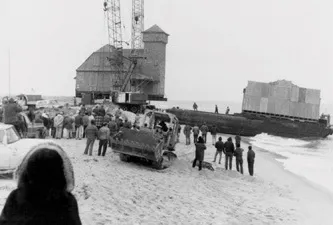
Large shingled cottages with wraparound porches began to appear on the bluffs overlooking the beach, their scale and aesthetic ambition entirely unlike anything the village had previously produced. Small hotels and boarding houses were constructed to accommodate visitors who could not afford the grander private establishments but who nonetheless wished to participate in the Ogunquit experience. Period photographs preserved in the museum's collection show Main Street in a state of visible transition during these years — old fishermen's buildings standing alongside newer commercial structures that catered explicitly to tourist needs, their signage advertising boat rentals, fresh lobster, and accommodations with sea views.
The Ogunquit Heritage Museum holds a particularly evocative set of photographs from the 1890s and early 1900s that document this architectural layering with unusual precision. In several images, it is possible to observe within a single frame the weathered clapboards of a pre-tourist-era dwelling standing in direct visual conversation with the more self-consciously picturesque design of a neighboring summer cottage. The contrast is striking and historically instructive.
Economic Opportunity and Its Complications
For some residents of Ogunquit, the summer visitor economy represented a genuine and welcome expansion of opportunity. Fishermen who had struggled through lean seasons found supplementary income in guiding excursions, selling catches directly to hotel kitchens, and renting rooms in their homes. Women who had previously operated within the narrow economic margins available to them in a fishing community discovered that the tourist trade created demand for domestic labor, needlework, and locally produced goods that had not previously existed at meaningful scale.
Newspaper accounts from the period, several of which have been digitized as part of the museum's ongoing preservation efforts, reflect this cautious optimism. A 1901 article in a regional paper notes with evident satisfaction that the summer season had brought "unusual prosperity" to local tradespeople and that the quality of visitors was such as to reflect well upon the town's growing reputation.
Yet the same archives also preserve evidence of a more complicated response. Letters and diary entries from established Ogunquit families describe a sense of unease at the pace of change, a feeling that the community's character was being altered in ways that could not be easily reversed. The arrival of wealthy visitors brought with it a set of social expectations and behavioral norms that did not always sit comfortably alongside the working-class culture of the fishing community. Accounts of friction over access to the beach, over noise and late-hour socializing, and over the transformation of quiet residential lanes into commercial thoroughfares appear with enough regularity in the historical record to suggest that the benefits of the tourist economy were not experienced uniformly.
Class, Culture, and the Contested Shore
The beach itself became a site of implicit negotiation during this period. For fishing families, the shore was a working environment — a place where boats were launched, nets were mended, and the practical business of making a living was conducted. For summer visitors, that same shoreline represented leisure, beauty, and escape from the pressures of urban professional life. These two ways of inhabiting the same physical space were not always compatible, and the historical record suggests that the balance shifted steadily in favor of the visitor economy as the decades passed.
Property records document this shift with particular clarity. Land adjacent to the beach, which had changed hands infrequently and at modest valuations for most of the nineteenth century, began to appreciate significantly in the 1890s as outside buyers recognized its potential for development. Several parcels that had been held by fishing families for generations were sold during this period, sometimes under circumstances that later accounts describe in terms suggesting financial pressure rather than voluntary choice.
The museum's collection of oral history recordings, gathered from descendants of Ogunquit's older families in the mid-twentieth century, preserves a nuanced memory of this transition. Speakers describe parents and grandparents who held genuinely ambivalent views about the summer visitors — grateful for the income they represented, protective of the community's autonomy, and sometimes quietly resentful of the assumptions that accompanied wealth and social privilege.
A New Identity Takes Shape
By the first decade of the twentieth century, Ogunquit's identity had been fundamentally and irreversibly altered. The town was no longer primarily a fishing village that happened to attract summer visitors; it had become a resort destination with an active fishing heritage. That distinction, subtle as it may appear on the surface, carried significant implications for how the community understood itself and how it projected that understanding to the outside world.
The arrival of the art colony — which would become one of Ogunquit's most celebrated cultural assets — was itself a product of this transformed identity. Artists were drawn to the town in part because of the infrastructure that tourist development had created: the boarding houses, the relative accessibility from urban centers, and the cultivated appreciation for scenic beauty that the resort culture had helped to establish. The fishing community and the summer visitor economy had, between them, created the conditions for a cultural flowering that neither could have produced independently.
Reading the Evidence Today
For visitors to the Ogunquit Heritage Museum, the Gilded Age collections offer an opportunity to engage with a period of transformation that resonates in ways that extend well beyond local history. The tensions between economic development and community identity, between the interests of established residents and the demands of outside capital, between preservation and change — these are not exclusively historical concerns. They are questions that communities across the United States continue to navigate, and the Ogunquit record provides a richly documented case study in how such negotiations have unfolded in the past.
The period photographs, property records, newspaper clippings, and personal accounts that document Ogunquit's Gilded Age transformation are more than historical artifacts. They are evidence of the complex, sometimes painful, and ultimately generative process by which a small Maine community discovered and defined itself in relation to the wider world.