Brushes, Barricades, and Brotherhood: How the Second World War Forged a New Ogunquit Art Colony
Long before the first summer tourist arrived each June, Ogunquit had already earned its reputation as one of the most fertile artistic environments on the Eastern Seaboard. The village's particular quality of light — that luminous, salt-softened glow that painters from Charles Woodbury onward had traveled great distances to capture — remained unchanged by the onset of global conflict. What changed, profoundly and permanently, was the human landscape through which that light moved.
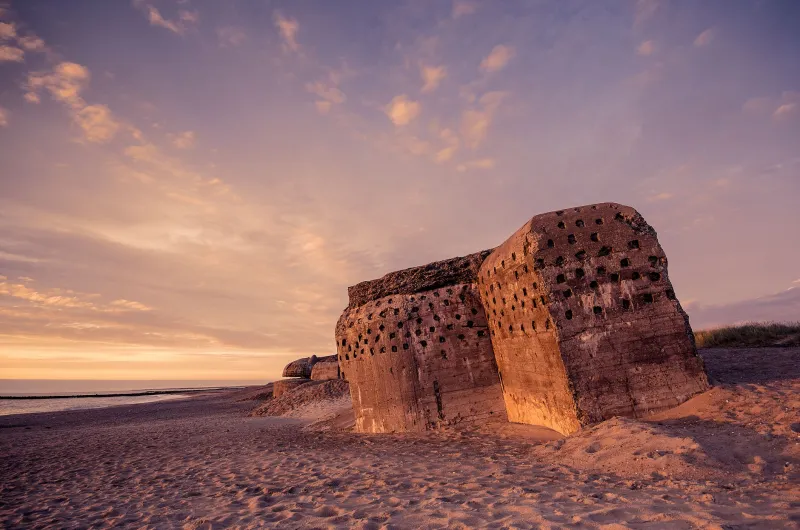
By the autumn of 1942, Ogunquit's once-crowded colony of painters, sculptors, and printmakers had thinned dramatically. Young men had enlisted or been drafted. Studios stood locked for seasons at a stretch. The lively summer critiques and open-air sketching sessions that had defined the colony's social rhythm fell quiet. And along the shoreline that had inspired countless canvases, the United States military had begun erecting concrete observation posts, stringing barbed wire across the dunes, and organizing coastal watch patrols that regarded any figure carrying an easel with immediate suspicion.
A Coastline Under Watch
The military presence along the southern Maine coast was not incidental. German U-boats had been active in the western Atlantic since early 1942, sinking merchant vessels with alarming regularity within sight of American shores. In response, the Army established a network of coastal defense installations stretching from Kittery to Kennebunkport, with Ogunquit's beach and surrounding headlands falling squarely within the designated security zone.
For artists who had built their lives around unrestricted access to the shore, the restrictions were disorienting. Painting outdoors — plein air work had been the colony's foundational practice since Woodbury's school opened in the 1890s — became logistically complicated and, in certain restricted zones, outright prohibited without military clearance. Artists found themselves painting from memory, from hastily made sketches, or from the more circumscribed vantage points that remained accessible. Some turned inward entirely, abandoning landscape work in favor of portraiture, still life, and abstraction.
What might have been a creative paralysis became, for many, an unexpected liberation.
Those Who Stayed and Those Who Served
The wartime colony was a community defined as much by absence as by presence. Among those who departed was a generation of younger artists who had come to Ogunquit in the late 1930s drawn by the colony's reputation and the instruction available through the Ogunquit School of Painting and Sculpture. Many of these men entered military service, some finding their artistic skills redirected toward cartography, camouflage design, and the production of instructional materials for the armed forces — roles that, while unglamorous, kept their hands and eyes engaged with visual problems.
Those who remained in Ogunquit during the war years occupied an unusual position. Older artists, women artists, and those whose health precluded service found themselves the custodians of a tradition whose future was genuinely uncertain. They continued to work, to teach when students could be found, and to exhibit in the limited venues that remained operational. Their wartime output represents a significant and still-underexamined chapter in Ogunquit's artistic record — one that the Ogunquit Heritage Museum has been actively working to document and preserve.
Among the women artists who maintained the colony's vitality during these years, several produced work of remarkable emotional directness. Portraits of local fishermen and their families, seascapes painted from restricted vantage points, domestic interiors rendered with a heightened attention to the textures of everyday life — these canvases carry within them the particular weight of a community holding itself together against uncertainty.
The Dunes as Document
Perhaps the most striking artistic response to the wartime transformation of Ogunquit's landscape was the decision by several painters to document the military installations themselves. Concrete bunkers, observation towers, and the angular geometry of barbed-wire fencing appeared in canvases that made no effort to aestheticize or soften the intrusion of war infrastructure into the coastal scenery. These works occupy a curious position in the colony's history — they are, simultaneously, records of disruption and demonstrations of the artist's instinct to find meaning in whatever the immediate environment presents.
These documentary canvases also serve as historical evidence of a kind that written records cannot fully replicate. The precise placement of fortifications, the appearance of the beach before post-war development altered it, the way in which military structures cast their shadows across the dunes — all of this is preserved in paint with a fidelity that aerial photographs and official military surveys cannot match for human scale and emotional texture.
Homecoming and Reinvention
When the war ended and the surviving members of Ogunquit's artistic community began to return, they encountered a village that had been changed by the experience of military occupation in ways both visible and subtle. The concrete observation posts would remain for years before their eventual demolition. The social fabric of the colony had been rewoven in their absence by those who stayed, and the returning veterans brought with them experiences — of Europe, of North Africa, of the Pacific — that fundamentally altered their relationship to the quiet Maine coastline they had left behind.
The post-war decade brought an influx of new artistic energy to Ogunquit. Veterans using the G.I. Bill to pursue art education arrived seeking instruction and community. European artists displaced by the war discovered in Ogunquit a refuge whose combination of natural beauty and established creative infrastructure suited their needs remarkably well. The colony that emerged from this convergence was more diverse, more cosmopolitan, and in certain respects more self-conscious about its own identity than the pre-war community had been.
The Ogunquit Art Association, which had maintained a reduced but continuous presence throughout the conflict, found itself navigating a membership that now included both the veterans of the pre-war colony and a new generation whose formative experiences had been shaped by global conflict. The tensions and cross-pollinations between these groups produced a creative environment of considerable vitality — one that would sustain Ogunquit's reputation as a significant artistic center well into the second half of the twentieth century.
A Legacy Written in Paint and Memory
The story of Ogunquit's artist colony during the Second World War is not one of simple heroism or uncomplicated resilience. It is a more textured account of a community that lost members, adapted to restriction, found unexpected creative resources in limitation, and ultimately emerged transformed rather than merely restored.
The Ogunquit Heritage Museum holds within its collections works produced during the war years alongside oral history recordings from artists and community members who lived through the period. Together, these materials offer a portrait of creative life under pressure — a reminder that the artistic tradition for which Ogunquit is celebrated was never simply a product of ideal conditions, but was built and rebuilt through the full range of human circumstance.
For visitors who walk the Marginal Way today, pausing to look out over the same Atlantic waters that wartime lookouts once scanned for periscopes, the landscape offers no obvious sign of what it once held. That invisibility is itself a kind of testament — to the resilience of the natural world, and to the artists who refused to stop looking at it, even when what they found there was difficult to see.